
United Nations and Artificial Intelligence
News
- AP, The UN adopts a resolution backing efforts to ensure artificial intelligence is safe, March 21, 2024, https://apnews.com/article/united-nations-artificial-intelligence-safety-resolution-vote-8079fe83111cced0f0717fdecefffb4d
- The White House, Statement from Vice President Harris on the UN General Assembly Resolution on Artificial Intelligence, March 21, 2024, https://www.whitehouse.gov/briefing-room/statements-releases/2024/03/21/statement-from-vice-president-harris-on-the-un-general-assembly-resolution-on-artificial-intelligence/
- The White House, Statement from National Security Advisor Jake Sullivan on the United Nations General Assembly Resolution on Artificial Intelligence for Sustainable Development, March 21, 2024, https://www.whitehouse.gov/briefing-room/statements-releases/2024/03/21/statement-from-national-security-advisor-jake-sullivan-on-the-united-nations-general-assembly-resolution-on-artificial-intelligence-for-sustainable-development/
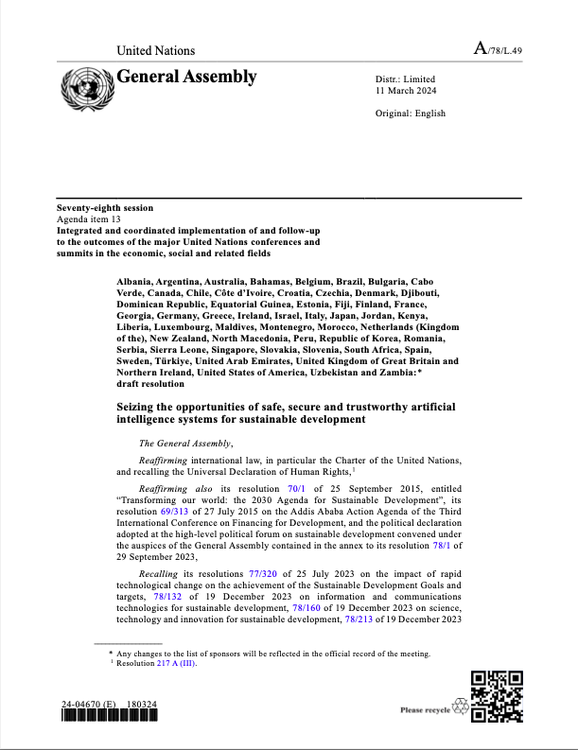
Seizing the opportunities of safe, secure and trustworthy artificial
intelligence systems for sustainable development
The General Assembly,
Reaffirming international law, in particular the Charter of the United, 11 March 2024, https://www.undocs.org/Home/Mobile?FinalSymbol=A%2F78%2FL.49&Language=E&DeviceType=Desktop&LangRequested=False

. . . The international community has a long history of responding to new technologies with the potential to disrupt our societies and economies. We have come together at the United Nations to set new international rules, sign new treaties and establish new global agencies. While many countries have called for different measures and initiatives around the governance of AI, this requires a universal approach.
And questions of governance will be complex for several reasons. First, powerful AI models are already widely available to the general public. Second, unlike nuclear material and chemical and biological agents, AI tools can be moved around the world leaving very little trace. And third, the private sector’s leading role in AI has few parallels in other strategic technologies.
But, we already have entry points. One is the 2018-2019 guiding principles on lethal autonomous weapons systems, agreed through the Convention on Certain Conventional Weapons. I agree with the large number of experts that have recommended the prohibition of lethal autonomous weapons without human control.
A second is the 2021 recommendations on the Ethics of Artificial Intelligence agreed through the United Nations Educational, Scientific and Cultural Organization (UNESCO). . . .
The need for global standards and approaches makes the United Nations the ideal place for this to happen. The Charter of the United Nations’ emphasis on protecting succeeding generations gives us a clear mandate to bring all stakeholders together around the collective mitigation of long-term global risks. AI poses just such a risk.
I therefore welcome calls from some Member States for the creation of a new United Nations entity to support collective efforts to govern this extraordinary technology, inspired by such models as the International Atomic Energy Agency (IAEA), the International Civil Aviation Organization (ICAO) or the Intergovernmental Panel on Climate Change. . . .
As a first step, I am convening a multistakeholder High-Level Advisory Board for Artificial Intelligence that will report back on the options for global AI governance, by the end of this year. My upcoming Policy Brief on A New Agenda for Peace will also make recommendations on AI governance to Member States.
First, it will recommend that Member States develop national strategies on the responsible design, development and use of AI, consistent with their obligations under international humanitarian law and human rights law.
Second, it will call on Member States to engage in a multilateral process to develop norms, rules and principles around military applications of AI, while ensuring the engagement of other relevant stakeholders.
Third, it will call on Member States to agree on a global framework to regulate and strengthen oversight mechanisms for the use of data-driven technology, including artificial intelligence, for counter-terrorism purposes. . . .
I urge this Council to exercise leadership on artificial intelligence and show the way towards common measures for the transparency, accountability, and oversight of AI systems. We must work together for AI that bridges social, digital and economic divides, not one that pushes us further apart. . . .
News
- Barron's, UN Chief Warns Of AI Risks To Global Peace (July 18, 2023)
- CNN, UN Secretary General embraces calls for a new UN agency on AI in the face of ‘potentially catastrophic and existential risks’ (July 18, 2023)
- Reuters, UN Security Council Holds First Talks on AI Risks (July 18, 2023)
- Youtube, United Nations Meet On Risks of Artificial Intelligence (July 18, 2023)
Country Statements
The UK's vision is founded on 4 irreducible principles:
- open: AI should support freedom and democracy
- responsible: AI should be consistent with the rule of law and human rights
- secure: AI should be safe and predictable by design; safeguarding property rights, privacy and national security
- resilient: AI should be trusted by the public and critical systems must be protected
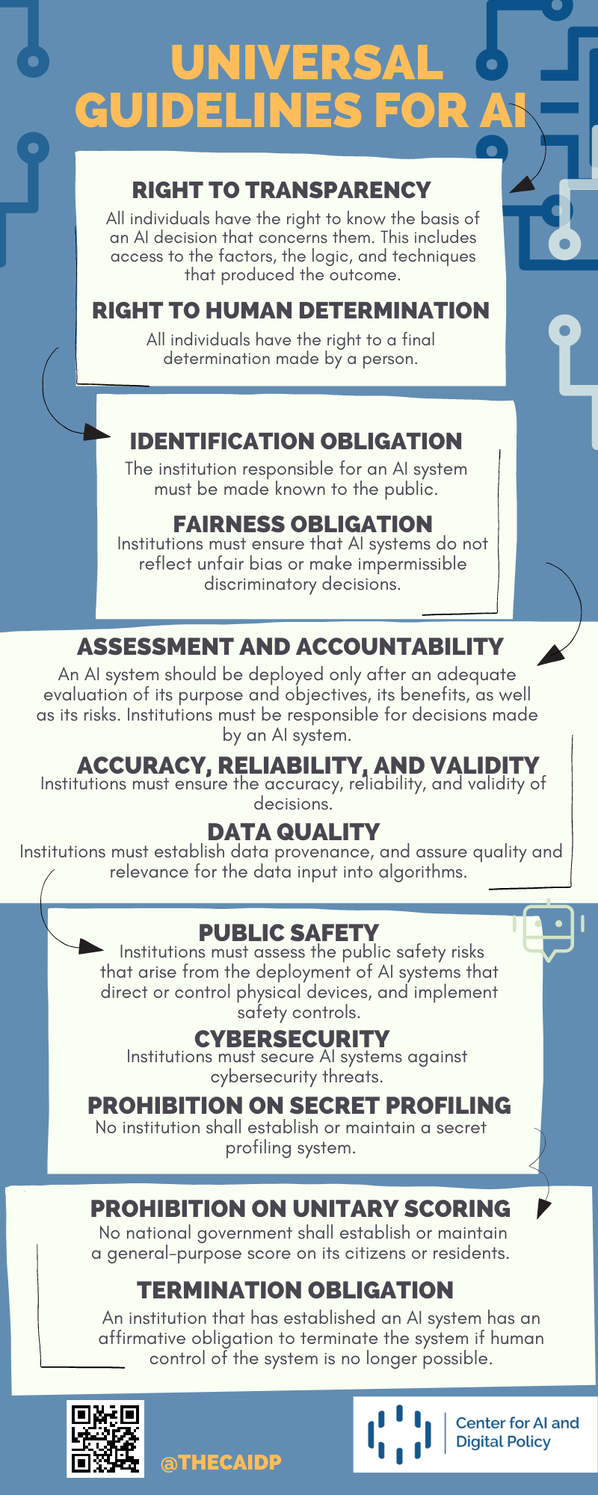
Universal Guidelines for AI (UGAI)
CAIDP Statements to the UN on AI
- CAIDP Statement to the Global Digital Compact (18 March 2026)
- CAIDP Statement to UN High Commissioner for Human Rights on the Urgent Need to Establish Red Lines (4 Oct. 2025)
- CAIDP Statement to the UN General Assembly (22 Sept. 2025)
- CAIDP Statement to the UN Office for Digital and Emerging Technologies for delivery at Global Digital Compact Stakeholder Townhall Meeting (16 June 2025)
- CAIDP’s Comments on Artificial Intelligence and Judicial Systems For the Special Rapporteur on the Independence of Judges and Lawyers, United Nations Office of the High Commissioner for Human Rights (2 May 2025)
- CAIDP Recommendations for the United Nations Human Rights Council on Addressing the Issue of Technology-facilitated Gender-based Violence and its Impact on Women and Girls (27 Feb. 2025)
- CAIDP Comments the Office of the United Nations High Commissioner for Human Rights Call on The Use of Artificial Intelligence and the UN Guiding Principles on Business and Human Rights (15 Jan. 2025)
- CAIDP Statement to the UN Global Digital Compact on AI and Human Rights (5 Aug. 2024)
- CAIDP, Global AI Governance A Five-Point Plan for the UN Advisory Board on AI - Recommendations Concerning Scientific Panel (30 Sept. 2023)

CAIDP Statement to the UN On AI and the Protection of Fundamental Rights (Dec. 9, 2022)
At the eve of Human Rights Day, the Center for AI and Digital Policy (CAIDP) submits this statement to you, (with a copy to the UN Tech Envoy) to recommend that the United Nations encourage countries to report on the impact of Artificial Intelligence on the fundamental rights set out in the International Covenant on Civil and Political Rights (ICCPR). This recommendation follows from the earlier work of the former High Commissioner and responds to growing concerns around the world that AI will adversely impact a wide array of fundamental rights. . . .
There is a clear interconnectedness between AI – systems, media, and the quality of democracy. How minorities, and vulnerable groups, e.g., children, people on the move, people with disabilities, are treated in policy and in practice can be a strong indicator of how human rights are respected by the government in a country. Neither should a government use AI as a manipulative and coercive instrument nor should it accept the inequality caused by AI technology.
AI technologies may adversely impact human rights. “The operation of AI systems can facilitate and deepen privacy intrusions” and “expand, intensify or incentivize interference with the right to privacy, most notably through increased collection and use of personal data.”
Article 1 – Self-determination
AI systems can undermine or constrain human autonomy. AI technologies are used to dynamically personalize an individual's choice environments, to nudge and manipulate behavior in unprecedented manners.21 According to Article 1 “All peoples have the right of self- determination. By virtue of that right they freely determine their political status and freely pursue their economic, social and cultural development[...]”.
- States parties should assess the impact of AI on the right of self-determination.
Article 9 – Liberty and Security
AI systems can trigger interventions by the State, such as searches, questioning, arrest and prosecution, even though AI assessments by themselves should not be seen as a basis for reasonable suspicion due to the probabilistic nature of the predictions.22 Therefore, rights to privacy, to a fair trial, to freedom from arbitrary arrest and detention and the right to life can be affected. Article 9 states that “everyone has the right to liberty and security of a person. No one shall be subjected to arbitrary arrest or detention. [...].
- States parties should assess the impact of AI on the right to liberty and security.
Article 10 – Inherent Dignity
The Secretary-General emphasized that advances in new technologies must not be used to erode human rights, deepen inequality or exacerbate existing discrimination. He stressed that the governance of AI needs to ensure fairness, accountability, explainability and transparency.23 According to Article 10, “All persons deprived of their liberty shall be treated with humanity and with respect for the inherent dignity of the human person.”
- States parties should assess the impact of AI on the right to inherent dignity.
Article 12 – Freedom of Movement
Remote biometric recognition dramatically increases the ability of State authorities to systematically identity and track individuals in public spaces, undermining the ability of people to go about their lives unobserved and resulting in a direct negative effect on the exercise of the rights to freedom of expression, of peaceful assembly and of association, as well as freedom of movement.24 Thus, the right to liberty of movement will be adversely impacted. Article 12 states that “everyone lawfully within the territory of a State shall, within that territory, have the right to liberty of movement and freedom to choose his residence [...].”
- States parties should assess the impact of AI on the right to freedom of movement.
Article 14 – Fair Trial
AI systems use algorithms to analyze large massive data sets, often biased and filled with inaccuracies, such as criminal records, arrest records, crime statistics, records of police interventions in specific neighborhoods, social media posts, communications data and travel records. “The technologies may be used to create profiles of people, identify places as likely to be sites of increased criminal or terrorist activity, and even flag individuals as likely suspects and future reoffenders.”25 According to Article 14 “all persons shall be equal before the courts and tribunals. In the determination of any criminal charge against him, or of his rights and obligations in a suit at law, everyone shall be entitled to a fair and public hearing by a competent, independent and impartial tribunal established by law.”
- States parties should assess the impact of AI on the right to a fair trial.
Article 17 – Privacy
Privacy is a fundamental human right, essential to live in dignity and security. “The operation of AI systems can facilitate and deepen privacy intrusions”26 and “expand, intensify or incentivize interference with the right to privacy, most notably through increased collection and use of personal data.”27 Article 17 states “ No one shall be subjected to arbitrary or unlawful interference with his privacy [...]” recognizes the right to privacy as a fundamental human right and is a foundational right for a democratic society. AI systems have a broad range of impact on people’s lives. The right to privacy is affected when AI systems are used to flag individuals as potentially infected or infectious, requiring them to isolate or to quarantine or used for the predictive allocation of grades resulted in outcomes that discriminated against students from public schools and poorer neighborhoods.28
- States parties should assess the impact of AI on the right to privacy.
Article 18 – Freedom of Thought
“AI-assisted content curation done by companies with enormous market power raises concerns about the impact on the capacity of the individual to form and develop opinions, as two successive holders of the mandate of Special Rapporteur on the promotion and protection of the right to freedom of opinion and expression have pointed out.”29 As evidenced under Article 18 that states “Everyone shall have the right to freedom of thought, conscience and religion [...].
- States parties should assess the impact of AI on the right to freedom of thought.
Article 20 – Disinformation and Incitement to Violence
People can use AI-powered technology to facilitate the spread of disinformation or influence public debate, they can use it to create and propagate content designed to incite war, discrimination, hostility, or violence. According to Article 20, “any propaganda for war shall be prohibited by law [...]”.
- States parties should assess the impact of AI on disinformation and incitement to violence.
Article 21 – Peaceful Assembly
AI-assisted content curation and AI recommender systems impact the capacity of individuals to form and develop opinions. These systems “focus on maximizing user engagement while relying on insights into people’s preferences, demographic and behavioral patterns, which has been shown to often promote sensationalist content, potentially reinforcing trends towards polarization”.30 This can influence provision of the right of peaceful assembly in Article 21 that states [...] “No restrictions may be placed on the exercise of this right ) to peaceful assembly) other than those imposed in conformity with the law [...]”.
- States parties should assess the impact of AI on the right to peaceful assembly.
Article 22 – Freedom of Association
“Remote biometric recognition dramatically increases the ability of State authorities to systematically identity and track individuals in public spaces, undermining the ability of people to go about their lives unobserved and resulting in a direct negative effect on the exercise of the rights to freedom of expression, of peaceful assembly and of association, as well as freedom of movement.”31 Article 22 states that “everyone shall have the right to freedom of association with others, including the right to form and join trade unions for the protection of his interests [...].”
- States parties should assess the impact of AI on the right to freedom of association.
Article 26 – Equal Protection
AI models are designed to sort and filter, profiling and categorizing people based on personal characteristics. This discrimination can interfere with human rights violating “entitlement without any discrimination to the equal protection of the law” under Article 26.
- States parties should assess the impact of AI on the right to equal protection of the law.
AI and Democratic Values (CAIDP 2026)
Pages 48-57 (footnotes omitted)
United Nations
The Secretary-General of the United Nations has led a global campaign for
AI governance over many years. Speaking in February 2025 at the AI Action Summit in Paris, Secretary-General António Guterres said, “We must all work together so that artificial intelligence can bridge the gap between developed and developing countries—not widen it. It must accelerate sustainable development—not entrench inequalities.”147 Guterres emphasized the need to ensure technology serves humanity, not the other way around. “The creation of an Independent International Scientific Panel on AI will be central to translating this vision into reality,” said the Secretary-General. He also called attention to the growing impact of AI on the climate and sustainability. He concluded, “It is in all our interests for Governments and technology leaders to commit to global guardrails, share best practices and shape fair policy and business models.”
The UN accomplished several milestones toward this goal in 2024. The Pact
for the Future, adopted by World Leaders at the Summit for the Future in September 2024, outlined several goals for AI aligned with the Sustainable Development Goals, including enhancing international governance of AI for the benefit of humanity.148 The Pact also warned of the “risks of existing and potential risks associated with the
military applications of artificial intelligence.”149 The Global Digital Compact, also
adopted at the Summit for the Future, established the first universal agreement on the governance of AI. The Compact reiterated calls for building AI capacity in
developing nations.
The UN implemented these initiatives in 2025 with the establishment of
International Scientific Panel on AI150 and the first informal Global Dialogue on AI
at the 80th General Assembly.151 The panel and dialogue reflect the UN’s centrality
in furthering global AI governance, a role validated by the BRICS Leaders’
recognition of the Global Dialogue as “an inclusive platform within the United
Nations for states and stakeholders to discuss the critical issues concerning AI facing
humanity today.”152
UNESCO
In 2020, UNESCO embarked on a project to develop a global standard for Artificial Intelligence. UNESCO Director General Audrey Azoulay stated, "Artificial intelligence can be a great opportunity to accelerate the achievement of sustainable development goals. But any technological revolution leads to new imbalances that we must anticipate.”153
The UNESCO Recommendation sets out about a dozen principles, five Action Goals, and eleven Policy Actions. Notable among the recommendations is the emphasis on Human Dignity, Inclusion, and Diversity. UNESCO also expresses support for Human Oversight, Privacy, Fairness, Transparency and Explainability, and Safety and Security, among other goals. Understandably, UNESCO is interested in the scientific, educational, and cultural dimensions of AI, the agency’s program focus.
The UNESCO Recommendation was adopted in 2021. This is the first global
agreement on the Ethics of Artificial Intelligence.154 UNESCO Director General
Audrey Azoulay stated, “The world needs rules for artificial intelligence to benefit
humanity. The recommendation on the ethics of AI is a major answer. It sets the first
global normative framework while giving member states the responsibility to apply
it at their level. UNESCO will support its 193 member states in its implementation
and ask them to report regularly on their progress and practices.”
UNESCO explained, “The Recommendation aims to realize the advantages
AI brings to society and reduce the risks it entails. It ensures that digital
transformations promote human rights and contribute to the achievement of the
Sustainable Development Goals, addressing issues around transparency,
accountability and privacy, with action-oriented policy chapters on data governance,
education, culture, labour, healthcare and the economy.” The key achievements of
the UNESCO AI Recommendation include:
- Protecting data. The UNESCO Recommendation calls for action beyond what tech firms and governments are doing to guarantee individuals more protection by ensuring transparency, agency and control over their personal data.
- Banning social scoring and mass surveillance. The UNESCO Recommendation explicitly bans these uses of AI systems.
- Monitoring and Evaluation. The UNESCO Recommendation establishes new tools that will assist in implementation, including Ethical Impact Assessments and a Readiness Assessment Methodology (RAM).
- Protecting the environment. The UNESCO Recommendation emphasizes that AI actors should favor data-, energy-, and resource-efficient AI methods to help ensure that AI becomes a more prominent tool in the fight against climate change and on tackling environmental issues.
The Recommendation aims to provide a basis to make AI systems work for the good of humanity, individuals, societies, and the environment and ecosystems, and to prevent harm. It also aims at stimulating the peaceful use of AI systems. The Recommendation provides a universal framework of values and principles of the
ethics of AI. It sets out four values: respect, protection, and promotion of human
rights and fundamental freedoms and human dignity; environment and ecosystem flourishing; ensuring diversity and inclusiveness; living in peaceful, just, and
interconnected societies.
Further, the Recommendation outlines 10 principles—proportionality and do no harm, safety and security, fairness and non-discrimination, sustainability, right to privacy and data protection, human oversight and determination, transparency and explainability, responsibility and accountability, awareness and literacy—backed by more concrete policy actions on how they can be achieved. The Recommendation
also introduces red lines to unacceptable AI practices. For example, it states that “AI
systems should not be used for social scoring or mass surveillance purposes.”
The Recommendation focuses not only on values and principles but also on
their practical realization via concrete eleven policy actions. UNESCO encourages
Member States to introduce frameworks for ethical impact assessments, oversight
mechanisms, etc. Member States should ensure that harms caused through AI
systems are investigated and redressed by enacting strong enforcement mechanisms
and remedial actions to make certain that human rights, fundamental freedoms, and
the rule of law are respected.
UNESCO developed the Readiness Assessment Methodology (RAM) to assist Member States in implementing the Recommendation.155 As of early 2026, UNESCO has supported more than 40 countries in assessing their readiness for AI integration along 5 dimensions: legal, social/cultural, scientific/educational, economic, and technical and infrastructural. Country profiles on UNESCO’s Global Hub156 include key insights and recommendations from the reports, revealing key action steps and common challenges as well as useful approaches to governing AI aligned to the Recommendation.
UNESCO’s Supervising AI by Competent Authorities157 project, with the
assistance of the Center for AI and Digital Policy, provided hands-on training to
“equip national authorities with the tools, knowledge, and peer support needed to
supervise AI systems effectively.” In 2025, the program delivered sessions to more
than 700 civil servants across 12 EU Member States. The program also produced an
AI Supervision Toolkit.158 CAIDP also assisted UNESCO on the AI Literacy Program for Civil Servants,159 as part of the AI Ethics Experts without Borders (AIEB) network. The program aims to advance national implementation of the UNESCO Recommendation by preparing government official and public services with the “knowledge, tools, and competencies that can help guide AI adoption in ways that uphold human rights, democracy, and the rule of law.” The European Commission Directorate-General for International Partnerships (DG INTPA) and the Patrick J. McGovern Foundation also support the project.
UN High Commissioner for Human Rights
In the Roadmap for Digital Cooperation, the UN Secretary-General stated, “To address the challenges and opportunities of protecting and advancing human rights, human dignity and human agency in a digitally interdependent age, the Office of the United Nations High Commissioner for Human Rights will develop system-wide guidance on human rights due diligence and impact assessments in the use of new technologies, including through engagement with civil society, external experts and those most vulnerable and affected.”160
In September 2021, the UN High Commissioner for Human Rights Michelle Bachelet called for a moratorium on the sale and use of AI that pose a serious risk to human rights until adequate safeguards are put in place.161 She also called for a ban on AI applications that do not comply with international human rights law. “Artificial intelligence can be a force for good, helping societies overcome some of the great challenges of our times. But AI technologies can have negative, even catastrophic, effects if they are used without sufficient regard to how they affect people’s human rights,” Bachelet said.
The High Commissioner’s statement accompanied the release of a new report on The Right to Privacy in the Digital Age. The UN Report details how AI systems rely on large datasets, with information about individuals collected, shared, merged, and analyzed in multiple and often opaque ways. The UN Report finds that data used to guide AI systems can be faulty, discriminatory, out of date, or irrelevant. Long-term storage of data also poses risks, as data could in the future be exploited in as yet unknown ways.162
UN Special Rapporteur
An extensive 2018 report by a UN Special Rapporteur explored the implications of artificial intelligence technologies for human rights in the information environment, focusing in particular on rights to freedom of opinion and expression, privacy, and non-discrimination.163 The Report of the Special Rapporteur on the Promotion and Protection of the Right to Freedom of Opinion and Expression defines key terms “essential to a human rights discussion about artificial intelligence”; identifies the human rights legal framework relevant to artificial intelligence; and presents preliminary guidelines to ensure that human rights are considered as AI systems evolve. The report emphasizes free expression concerns and notes several frameworks, including the International Covenant on Civil and Political Rights and the UN Guiding Principles on Business and Human Rights.
Among the Recommendations, the Special Rapporteur proposed “Companies should make all artificial intelligence code fully auditable and should pursue innovative means for enabling external and independent auditing of artificial intelligence systems, separately from regulatory requirements. The results of artificial intelligence audits should themselves be made public.” The report emphasizes the need for transparency in the administration of public services. “When an artificial intelligence application is being used by a public sector agency, refusal on the part of the vendor to be transparent about the operation of the system would be incompatible with the public body’s own accountability obligations,” the report advises.
An article published in 2024 by the CAIDP founder urged the creation of a Special Rapporteur for AI and Human Rights.164 Rotenberg wrote, “to effectively navigate the intricate landscape of AI and human rights, there is a pressing need for the creation of a UN Special Rapporteur on AI and Human Rights. This role would not only complement existing efforts but also provide the agility, authority, and competence required to address emerging challenges and safeguard human rights in the digital age.”
UN and Lethal Autonomous Weapons
In 2024, the UN Secretary-General urged the Security Council to act decisively to establish international guardrails for artificial intelligence, warning that delays could heighten risks to global peace and security.165 “Every moment of delay
in establishing international guardrails increases the risk for us all,” Mr. Guterres
said. “No country should design, develop, deploy or use military applications of AI
in armed conflict that violate international humanitarian and human rights laws.”
“Recent conflicts have become testing grounds for AI military applications,” he said,
citing AI use in autonomous surveillance, predictive policing, and even reported life-
and-death decisions.
Particularly alarming, he underscored, is the potential integration of AI with nuclear weapons and the advent of quantum-AI systems that could destabilize global security. “The fate of humanity must never be left to the ‘black box’ of an algorithm,”he stated, stressing the importance of human control over decisions involving the use of force.
The Secretary-General’s remarks follow a long history of efforts to establish rules to limit the use of AI systems in warfare. In fact, one of the first AI applications to focus the attention of global policymakers was the use of AI for warfare.166 In 2016, the United Nations established the Group of Governmental Experts (GGE) on Lethal Autonomous Weapons Systems (LAWS) following a review of the High Contracting Parties to the Convention on Certain Conventional Weapons (CCW).167
In November 2019,168 the CCW High Contracting Parties endorsed 11 Guiding
Principles for LAWS.169 But concerns about the future of regulation of lethal autonomous weapons remain. At present, some countries believe that current international law “mostly suffices” while others believe new laws are needed.170
Human Rights Watch provided an important overview of country positions on the future of banning fully autonomous weapons in August 2020.171 Concerns over killer reports also arose at the 75th UN Assembly in October 2020. Pope Francis warned that lethal autonomous weapons systems would “irreversibly alter the nature of warfare, detaching it further from human agency.” He called on states to “break with the present climate of distrust” that is leading to “an erosion of multilateralism, which is all the more serious in light of the development of new forms of military technology.”172 The Permanent Representative of the Holy See to the UN called for a ban on autonomous weapons in 2014.173
At the 2022 UN General Assembly, 70 countries endorsed a joint statement on autonomous weapons systems. The joint statement urged “the international community to further their understanding and address these risks and challenges by adopting appropriate rules and measures, such as principles, good practices, limitations and constraints. We are committed to upholding and strengthening compliance with International Law, in particular International Humanitarian Law,
including through maintaining human responsibility and accountability in the use of
force.”174
At the 78th UN General Assembly First Committee in 2023, 164 states voted
in favor175 of resolution L.56176 on autonomous weapons systems. The Resolution
emphasizes the “urgent need for the international community to address the
challenges and concerns raised by autonomous weapons systems,” and mandated the
UN Secretary-General to prepare a report reflecting the views of member and
observer states on autonomous weapons systems. The report presented in July 2024
summarized views from more than 40 Member and Observer States and 28 civil
society organizations.177 The statements reflect a breadth of perspectives and
concerns over defining LAWS and whether international law is sufficient for
governing these weapons or a new instrument should be developed. Questions about the best approach remain but the Secretary-General noted the urgency “to take preventative action on this issue” and reiterated his call for “the conclusion by 2026, of a legally binding instrument to prohibit lethal autonomous weapons that function without human control or oversight and that cannot be used in compliance with international humanitarian law.”178 He concluded, “The autonomous targeting of humans by machines is a moral line that must not be crossed.”
The 80th UN General Assembly furthered support for an international instrument to ensure the development and use of lethal autonomous weapons (LAWS) align with international humanitarian law. Negotiations for a treaty pushed forward with only 5 countries opposing and 5 abstaining on a resolution to extend conversations on beyond the GGE to informal discussions on emerging normative proposals at the General Assembly.179 Countries also overwhelmingly supported ongoing dialogue on artificial intelligence in the military domain more broadly. 118 delegations supported180 a draft resolution demanding human control and oversight over the command, control, and communications systems of nuclear weapons.181
These resolutions encourage the Convention on Certain Conventional Weapons (CCW) Group of Governmental Experts (GGE) on LAWS to continue toward an international instrument by the end of 2026