
Hiroshima AI Process
CAIDP is a member of the Hiroshima AI Process Friends Group Partners' Community
“CAIDP was recently designated as one of the first civil society members of the Hiroshima AI Process Friends Group.”
News
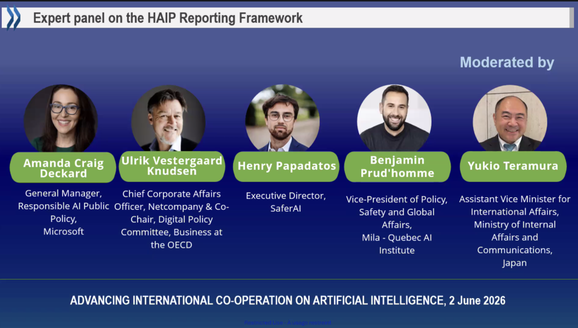
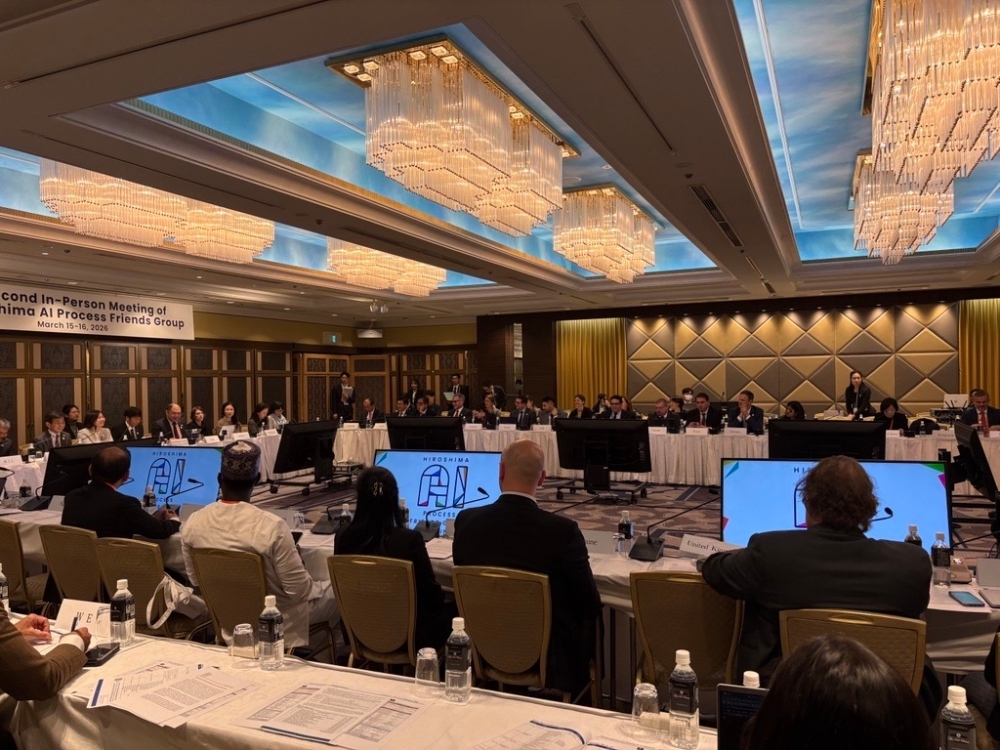
Following suggestions from CAIDP and others, version 2.0 simplifies reporting to facilitate participation for small and medium enterprises; distinguishes the roles of model developers, application developers, and deployers; connects to the OECD.AI Catalogue of Tools and Metrics; and adds coverage of emerging capabilities such as agentic AI. More than 50 organizations, including Google, OpenAI, Microsoft, Fujitsu, NEC, and Salesforce, have committed to reporting under the new framework. Reports will be filed at oecd.ai/transparency, with a 1 September 2026 deadline for inclusion in the next analytical review.

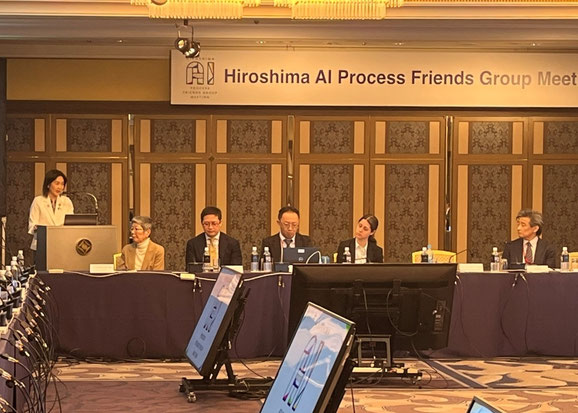
At the closing ceremony of the 2nd in-person Friends Group meeting, the Hiroshima AI Process Friends Group Action Plan 2026 was announced. Parliamentary Vice-Minister for Foreign Affairs SHIMADA Tomoaki delivered the closing remarks.
Japan’s Ministry of Internal Affairs and Communications announced that ten organizations, including the Center for AI and Digital Policy, had joined the Partners' Community.
The G7 Hiroshima AI Process Reporting Framework opened at transparency.oecd.ai. As of 4 May 2026, 25 organizations had published reports under the Framework, and a v2.0 pilot was open as of March 2026.
Held at the Hotel New Otani. Parliamentary Vice-Minister for Foreign Affairs IKUINA Akiko delivered the closing remarks. The Partners' Community was announced on Day 2 with 16 founding organizations.
66 Friends Group countries · 38 Partners' Community organizations
SELECTED PARTNERS' COMMUNITY MEMBERS
- Center for AI and Digital Policy (CAIDP)
- Adobe · Amazon · Anthropic
- Box Japan · Business Software Alliance · Fujitsu
- Google · Hitachi · IBM · Impact AI
- Infosys · ISACA · JICA · KDDI
- Microsoft · Mila · NEC · NTT
- OECD · OpenAI · Oracle Japan · Palo Alto Networks
- Preferred Networks · Rakuten · SaferAI · Salesforce · SoftBank
- UNDP · United Nations University · World Bank · World Economic Forum
Full membership list (MIC, Japan)
FIRST WAVE OF PUBLIC HAIP REPORTS — 22 APRIL 2025
- Anthropic · Google · Microsoft · OpenAI · Salesforce
- NEC · NTT · Fujitsu · KDDI · SoftBank · Rakuten · Preferred Networks
- ai21 · KYP.ai · Data Privacy and AI · TELUS · Fayston Preparatory School
Background
The Hiroshima AI Process (HAIP) was launched at the G7 Hiroshima Summit in May 2023 under Japan’s G7 Presidency, with the objective of discussing the opportunities and risks of generative AI and promoting safe, secure, and trustworthy advanced AI.
On 30 October 2023, the G7 Leaders agreed the Hiroshima AI Process Comprehensive Policy Framework, comprising the International Guiding Principles for Organizations Developing Advanced AI Systems and the International Code of Conduct for Organizations Developing Advanced AI Systems.
Since 2024, HAIP has been operationalised through three structures: the Friends Group, launched by Japan in May 2024; the Partners' Community, launched in February 2025; and the OECD HAIP Reporting Framework, launched on 7 February 2025.
Successive G7 presidencies have reaffirmed and extended HAIP: Italy in 2024 at Trento, Apulia and Cernobbio; Canada in 2025 at Kananaskis and Montréal; and France in 2026.
Timeline
Core Documents (2023, Japanese Presidency)
G7 Leaders' Statement on the Hiroshima AI Process — 30 October 2023
The G7 Leaders endorse the Comprehensive Policy Framework, attaching the International Guiding Principles and the International Code of Conduct.
Hiroshima Process International Guiding Principles for Organizations Developing Advanced AI Systems
11-point set of voluntary principles for organizations developing advanced AI systems. Companion to the Code of Conduct.
Hiroshima Process International Code of Conduct for Organizations Developing Advanced AI Systems
11 voluntary actions across the AI lifecycle: risk identification, post-deployment vulnerability monitoring, public reporting, information sharing, AI governance and risk management, security controls, content provenance, safety research, AI for global challenges, technical standards, and data input safeguards.
G7 Italian Presidency (2024)
Trento Ministerial Declaration on Industry, Technology and Digital — 15 March 2024
Annex 3 is dedicated to HAIP and tasks the OECD with developing monitoring tools for the Code of Conduct.
Apulia G7 Leaders' Communiqué — 13–15 June 2024
G7 Leaders reaffirmed their commitment to developing the HAIP Reporting Framework in cooperation with the OECD. The OECD subsequently ran a pilot from 9 July to 6 September 2024 with 20 organizations across 10 countries.
Cernobbio G7 Tech and Digital Ministerial Statement — 15 October 2024
G7 Digital and Tech Ministers reviewed the OECD pilot results and committed to advancing the Reporting Framework by year-end.
G7 Canadian Presidency (2025)
G7 Leaders' Statement on AI for Prosperity — Kananaskis, 17 June 2025
G7 Leaders launched the G7 AI Adoption Roadmap. Its trust-building pillar is explicitly grounded in HAIP.
G7 2025 Industry, Digital and Technology Ministerial Declaration — Montréal, 9 December 2025
G7 IDT Ministers asked the OECD to make the published HAIP reports easier for users and stakeholders to understand.
Implementing the G7 AI Adoption Roadmap — Montréal, 9 December 2025
Country-by-country implementation snapshot of the Roadmap. The “Unlock AI Opportunity Through Trust-building” section is grounded in HAIP.
Friends Group In-Person Meetings
2ND IN-PERSON FRIENDS GROUP MEETING — TOKYO, 15–16 MARCH 2026
Held at the Hotel New Otani. The HAIP Friends Group Action Plan 2026 was announced at the closing ceremony. Closing remarks by Parliamentary Vice-Minister for Foreign Affairs SHIMADA Tomoaki.


MOFA press release, 16 March 2026 · HAIP Friends Group Action Plan 2026 (PDF)
1ST IN-PERSON FRIENDS GROUP MEETING — TOKYO, 27–28 FEBRUARY 2025
Held at the Hotel New Otani. Day 1 included a video message from Prime Minister Ishiba, a keynote from Prof. Matsuo of the University of Tokyo, and site visits to NEC and NICT. Day 2 announced the launch of the Partners' Community. Closing remarks by Parliamentary Vice-Minister for Foreign Affairs IKUINA Akiko.


MOFA press release, 28 February 2025 · MIC: Results of the Friends Group Meeting
OECD HAIP Reporting Framework
Launched on 7 February 2025 as the operational mechanism through which organizations report on their alignment with the HAIP Code of Conduct's eleven actions. The Framework was developed in collaboration with stakeholder communities, incorporating input from government, the private sector, academia, civil society, and research institutions.
v2.0 update (March 2026): The OECD has announced that the HAIP Reporting Framework is being streamlined and improved. A v2.0 pilot is open for new submissions.
Links: transparency.oecd.ai · About the Framework · Submitted reports
CAIDP Statements on HAIP
Statement on AI Policy for Democratic Nations — 2025 G7 Summit Meeting (2 June 2025)
CAIDP welcomed HAIP as critical progress while urging the G7 to translate voluntary HAIP principles into enforceable rights-protecting law.
CAIDP recommendations to the G7 Leaders at Kananaskis:
- Ratify the Council of Europe Framework Convention on AI, human rights, democracy, and the rule of law.
- Establish clear red lines prohibiting AI technologies that violate human rights, plus a termination obligation for AI systems that evade human control.
- Ensure AI standards such as transparency, contestability, and human oversight for all rights-impacting AI systems.
- Adopt the recommendations of the G7 Data Protection Authorities.
Statement for the G7 Data Protection and Privacy Authorities Roundtable (12 June 2025)
CAIDP commended the G7 DPAs for their foundational contribution to HAIP, and connected HAIP transparency to enforceable user rights and to Data Free Flow with Trust (DFFT).
CAIDP recommendations to the G7 DPAs:
- Establish clear red lines prohibiting AI systems that breach data protection laws or exploit personal data in contravention of human rights.
- Endorse a termination obligation for AI systems that evade human control.
- Enforce the principles in the G7 DPAs' Statement on AI and Children.
- Clarify enforceable standards for transparency, contestability and human oversight for all rights-impacting AI systems.
- Clarify standards for Privacy Enhancing Technologies (PETs) within Data Free Flow with Trust (DFFT).
CAIDP Analysis
HAIP is also covered in CAIDP's AI and Democratic Values Index 2025 and in CAIDP's broader G7 work.
Cross-links: CAIDP AI Index 2025 · CAIDP G7 resource page · CAIDP Council of Europe AI Treaty resource page
Hiroshima AI Process — Documents of Achievement
Maintained by the Ministry of Internal Affairs and Communications of Japan.
2023 (Japan)
- G7 Leaders' Statement on the Hiroshima AI Process — 30 October 2023
- Hiroshima Process International Guiding Principles for Organizations Developing Advanced AI Systems
- Hiroshima Process International Code of Conduct for Organizations Developing Advanced AI Systems
- Hiroshima AI Process G7 Digital & Tech Minister's Statement — 1 December 2023
- Hiroshima AI Process International Guiding Principles for All AI Actors
- G7 Leaders' Statement — 6 December 2023
2024 (Italy)
- G7 Industry, Technology and Digital Ministerial Declaration and Annex 3 “Advancing the Outcomes of the Hiroshima AI Process” — 15 March 2024
- G7 Joint Statement — 15 October 2024
2025 (Canada)
- G7 2025 Industry, Digital and Technology Ministerial Declaration — 9 December 2025
- G7 Industry, Digital and Technology Ministerial Statement on the SME AI Adoption Blueprint Toolkit